
D4D Services – Overview
BACKGROUND

Too often people with a disability aren’t able to care for their diabetes in the same way as people without a disability. Customised strategies to remove barriers created by their disability are required but mainstream diabetes health services, generally, do not provide these services.
The National Disability Insurance Scheme (NDIS) funds capacity building strategies and resources to build the capacity of people with a disability to care for their diabetes, like they would if they did not have their disability.
THE D4D STRATEGY
EdHealth created a suite of services, that they customise and combine to create a Diabetes 4 Disability (D4D) solution. The aim is to build the capacity of NDIS participants, and their circle of support, to improve the ability of the person to have their diabetes care attended. We identify barriers their disability creates and design a solution that enables them to increase their capacity to do their diabetes self-care for better health. In other words, we focus on the disability side of a person’s diabetes care to enable the NDIS participant to put the diabetes care recommended by their health services into action.
EdHealth Australia’s Credentialled Diabetes Educators choose and customise D4D services/resources, from our suite of twelve, to maximise the capacity of their circle of support to actively involve the person in their diabetes care. These services are layered around the individual, for a comprehensive approach to their support – known as the D4D solution.
Services are individualised and suit people with:
- acquired brain injury
- autism
- cognitive disability
- intellectual disability
- psycho-social disability.
A focus on the disability side of diabetes care opens up a person’s capacity to better look after their diabetes. When the right support is in place for the person and their circle of support, improved diabetes care becomes a reality. This is different to the services provided in hospital and primary care-based diabetes education services, and why we are a NDIS Registered Provider.
EdHealth’s Credentialled Diabetes Educators work with the person and their team to make sure the supports are introduced and understood. Our aim is to improve their quality of life and health outcomes, while better supporting those providing their support.
Click! to find out why we recommend a support worker model of diabetes support for most NDIS participants.
Click! to find out why support workers can legally give insulin
DIABETES 4 DISABILITY (D4D) SERVICES
1. D4D ONLINE TRAINING

D4D Support Worker Training The D4D online training provides support workers with a solid understanding of diabetes. Modules are combined to address the knowledge and skills support workers need to help their client with their unique version of diabetes. NDIS compliant, this course has been written for the specific needs of support workers working with NDIS participants. A more comprehensive and effective option to set your support workers up to provide quality and safe diabetes care.
Click! for more information about the D4D Modules, Online Skill Sessions and Online Skill Check we use to customise the training for your support workers.
Click! Trouble shooting + Support to find out about trouble shooting and support provided by EdHealth
Click! to go to D4D Course Q&A.
2. ASSESSMENT
An in person or online assessment, conducted by an EdHealth diabetes educator, delivers customised solutions for better diabetes care for people with a disability.
Click! to find out more.
3. REPORT
EdHealth’s D4D report service can be used to provide an objective and comprehensive review of a NDIS participant’s diabetes care and support needs. After an assessment, the Credentialled Diabetes Educator/diabetes educator writes a report, focused on the support a NDIS participant and their circle of support will require, to care for their diabetes, like they would if they did not have their disability.
Click! to find out more.
4. DIABETES MANAGEMENT PLAN

NDIS participants require a written Diabetes Management Plan (DMP) when they have support workers helping them with their diabetes care. EdHealth creates DMPs to address the specific needs of the NDIS participant, their disability and specific diabetes care needs.
Click! to find out more.
5. DIABETES MANAGEMENT PLAN (DMP) QUIZ AND ANSWER GUIDE

A ten to thirteen question quiz can be prepared for support workers to complete after they have read through the DMP. The aim of this strategy is for them to understand and be able to show they have a solid understanding of the top ten areas of their client’s diabetes care. This quality and safety strategy supports a timely understanding of the DMP by a person’s support workers.
Click! to find out more.
6. DIABETES MANAGEMENT PLAN PRESENTATION

Providing the support workers with a presentation on the use of the Diabetes Management Plan (DMP) is recommended when an EdHealth DMP is prepared for a NDIS participant. This service will improve how the DMP is used by their support workers and complements the training provided in the D4D online training.
Click! to find out more.
7. LOW LITERACY RESOURCES

Low literacy, or picture resources, are designed by EdHealth CDEs for people with low literacy and/or low health literacy to support them with their diabetes care. These resources are designed to address a particular need and are highly individualised. Created using Widgit Online, the resources are very clear and effective at supporting a person to be more involved in their diabetes care. Some are designed to be interactive, where a person can add stickers to ‘count’ how often they do the task.
Click! to find out more.
8. LOW LITERACY EDUCATION SESSIONS
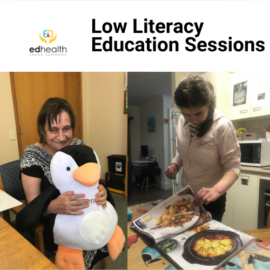
EdHealth’s team of Credentialled Diabetes Educators/diabetes educators have developed their skills in providing low literacy education sessions. These sessions are not readily available in mainstream diabetes education services, and are designed to address the needs of people with a significant cognitive disability.
Options include:
- Play therapy to de-sensitise/prepare a person who has refused to have an injectable diabetes treatment due to their fear of needles.
- Review and delivery of low literacy education if unable to tolerate mainstream health services.
- Education to use diabetes support equipment in their own home
- Introduction of a specific low literacy support service to demonstrate to the support workers.
Click! to find out more.
9. D4D RESOURCES

EdHealth creates resources to support health professionals and disability organisations to deliver quality and safe services to people with diabetes and a disability.
We will be increasing the resources available via the EdHealth Shop in the future.
In the mean time, Click! to go to the Shop and explore the resources you can already purchase.
EdHealth Contact Details:
Talk to the EdHealth team about a customised D4D Solution for your client.
Email: office@edhealth.com.au Phone: 0412 102 048