
Post BGM Strip Restrictions – What’s the impact?
Credentialled Diabetes Educator Jayne Lehmann previously commented, in her two-part blog, on restriction to BGM strips, and implications for CDEs. Here she continues the discussion, exploring anecdotal reactions, responses and the fallout for people with diabetes not on insulin since the restriction to strips began.
At least 789,985 Australians (1) have had life with diabetes made even harder since the 2014 Royal Australian College of General Practitioner’s (RACGP) recommendations stated self blood glucose monitoring (SBGM) was no longer required for people with type 2 diabetes not on insulin or sulphonylureas (2). The Commonwealth Government followed on in July 2016, announcing the introduction of restrictions to BGM strips for people with diabetes not on insulin, removing strips from the Pharmaceutical Benefits Scheme at the same time.
What impact has restricted access to BGM strips had on non-insulin users with diabetes?
Primary care and community pharmacies have borne the brunt of the change. Kirrily Chambers, Credentialled Diabetes Educator (CDE) and pharmacist in Stirling, South Australia, said, “Some people still don’t realise the restrictions are in place … when they have the restriction explained they have a sense of panic and frustration.” Kirrily continued, “…their ability to self manage their condition is removed and being able to have immediate feedback about their condition no longer applies.” At the same time there has been a drop-off in referrals to Credentialled Diabetes Educators because the need to blood glucose monitor often triggered referral of the newly diagnosed person with type 2 diabetes.
Official numbers on the impact of restrictions won’t be available for some time. However, word on the street tells me NDSS strip sales dropped considerably this year with one pharmacist telling me of a 20% drop in NDSS strip sales this calendar year. As everyone transitions to full restrictions in the the middle of 2017 and stockpiled strips dwindle, a further drop in SBGM rates is likely.
RACGP guidelines cause confusion – BGM by people not on insulin stopped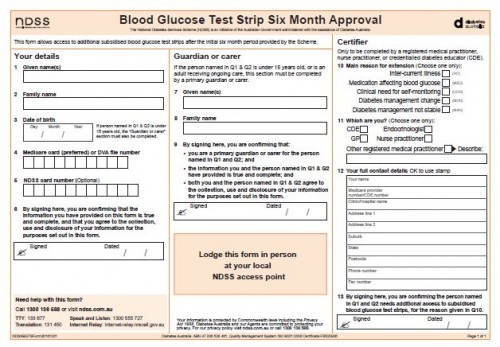
People with diabetes not on insulin are at times being told by their GP and/or primary care nurses to stop checking blood glucose levels (BGL). The GP instead monitors their glycosylated haemoglobin (HbA1c) 1-4 times a year.
People with diabetes not on insulin can access strips if they fulfill one of five criterion set by the Commonwealth Government. For example, people with type 2 diabetes prescribed a sulphonylurea (see PBS clip below for medication trade names available in Australia) can check their levels with a tick of the “Medication affecting blood glucose” box on the NDSS “Blood Glucose Test Strip Six Month Approval” form. This is due to their increased risk of hypoglycaemia. A new form needs to be signed 6 monthly for ongoing strip access.
Glycosylated haemoglobin (HbA1c) inaccuracies If people are to be denied access to BGM strips and monitored using only the HbA1c blood test then one assumes it is accurate. But it isn’t always accurate. If a person has a condition affecting their red blood cells it is often inaccurate. In fact, I see so many people with a low haemoglobin in my clinical practice, I feel I can no longer trust the HbA1c unless I check their latest haematology blood test. If that shows all is well with their red blood cells I’m happy to use the HbA1c results.
My actions were vindicated with the recent reporting of a study in Perth that identified 1 in 6 (12-18%) people with diabetes with a low haemoglobin (3) making their HbA1c inaccurate.
“How can we continue to say the HbA1c test provides us with the ‘gold standard’ of diabetes management review?” Jayne Lehmann
Can people with diabetes not on insulin still check their BGLs? Yes they can.
Newly diagnosed with type 2 diabetes: Able to monitor for the first six months post diagnosis with the completion of the NDSS registration form. They then have the form signed six monthly after this to continue to review their levels as a clinical need while getting levels stabilised and learning more about their condition.
Type 2 diabetes not on insulin: Can monitor after an assessment by their CDE, GP or Nurse Practitioner and form signed for ongoing strip access if they fit one of the following criteria:
- The person has an inter-current illness that may adversely affect blood glucose control
- The person is undergoing treatment with a medicine that may adversely affect blood glucose control
- The person’s diabetes is inadequately controlled
- There is a clinical need for the person to self-monitor their blood glucose control
- There has been a change to the person’s existing diabetes management within the previous three (3) months.
 Most people I see fit the criteria. They have a clinical need to monitor when I assess and evaluate their diabetes care. If people are to do the intermittent SBGM recommended in the criterion above, they require in-date strips at the time they are sick, if levels become unstable or medications changed. I sign the form and show them how to “Check, Think and Act” on their structured blood glucose monitoring results.
It is the quality, not the quantity of the monitoring that makes all of the difference. Less strips are used and with people acting on their results they achieve better health – exactly what the Commonwealth Government wants to achieve from the restrictions.
Conclusion There are significantly less people with diabetes actively involved in checking blood glucose levels since strips were restricted in those not on insulin. The nuances of the criteria to approve strip access will need to be better understood by primary care health professionals if we are to prevent increased rates of microvascular disease in the future from falsely low HbA1c results masking high blood glucose levels.
Refer to a Credentialled Diabetes Educator for a six (6) monthly assessment and review to see if they are eligible for BGM strips. If they are, now only will they learn to get quality results with less checks using structured blood glucose monitoring, they will also get shown how to check, think and act on their blood glucose levels for good health.
Now that’s a good outcome for everyone.
Want to find out more about Jayne Lehmann’s diabetes assessment and education services? Click here.
South Australian referrals can be faxed to Jayne on 08 8271 0947 or emailed to jayne@edhealth.com.au.
Download NDSS Blood Glucose Test Six Months Access Form here.
References:
- NDSS Website, www.static.diabetesaustralia.com.au/s/fileassets/diabetes-australia/e3105a1a-3eb4-4041-a5ab-96cd0fd31828.pdf. Accessed 22/5/2017 at 2.54pm.
- The Royal Australian College of General Practitioners. General Practice management of type 2 diabetes; 2016-18. East Melbourne, Vic: RACGP, 2016. P.50.
- Journal of Diabetes and its Complications http://www.jdcjournal.com/article/S1056-8727(16)31103-5/fulltext. Accessed 29/5/2017 at 1.29pm.