The Resources Exist—But Are Health Professionals Using Them?
Written by Jayne Lehmann, Director, EdHealth Australia
Health professionals often say they want to provide equitable, person-centred care. Yet when professional development competes with busy clinics, growing caseloads and administrative demands, education about intellectual disability can be pushed aside. It may be seen as relevant only to disability specialists or to a small group of patients.
That assumption is part of the problem. In yesterday’s post I shared the National Diabetes Services Scheme free resources available for people with intellectual disability, families, support workers and health professionals. These include accessible diabetes information and online learning designed to help clinicians adapt communication, involve supporters appropriately and respond more effectively to the needs of people with intellectual disability.
I was privileged to contribute to the development and later updating of these resources, including the online course. They provide an important and practical starting point.
But resources only create change when people use them.
When “too busy” becomes a safety issue
I understand the pressures health professionals face. There is never enough time for every professional development opportunity.
However, not developing capability in intellectual disability does not make the need disappear.
Instead, people can bounce between disability services and emergency medical care. Support workers recognise that something is wrong and seek medical help. The immediate crisis may be managed, but the underlying problem is not always fully identified or reviewed. The person is then discharged back to workers who may still lack the clinical guidance or authority to address it.
The disability system says, “This is a health issue.”
The health system manages the immediate problem and returns the person to disability support.
The person remains caught between both.
Bias influences what we choose to learn
Time is not the only barrier. Bias can influence which professional development we consider important.
Intellectual disability may be viewed as too complex, outside a clinician’s role or less relevant than education about new medicines, technology or mainstream self-management.
There is also a risk of diagnostic overshadowing, where pain, illness or changes in behaviour are attributed to the person’s disability rather than investigated as possible signs of a health problem.
In diabetes care, changes in behaviour, appetite, sleep, participation or communication may be associated with hypoglycaemia, hyperglycaemia, infection, medication effects, pain or another emerging condition.
Diabetes expertise is not automatically disability capability
A health professional can be highly experienced in diabetes and still need additional skills to work effectively with a person who has intellectual disability.
This includes adapting communication, making reasonable adjustments, recognising non-verbal signs of deterioration, working effectively with families and support workers, and translating clinical recommendations into strategies that can be safely implemented in everyday life.
This is where EdHealth Australia’s Diabetes 4 Disability approach builds additional layers and strategies into each system of diabetes support we create around people with intellectual and other cognitive disabilities. The NDSS resources introduce essential knowledge and Diabetes 4 Disability focuses on translating that knowledge into practical capability, safer systems of support, better clinical governance and improved interaction within the disability and health intersect. This is how we deliver better health to people with intellectual disability in the future.
A practical challenge to health professionals
During Sarah’s final hospitalisation, four months before she died at 25 years of age, she had been admitted after experiencing 12 seizures in one day.
It was not until the fifth day that I, her mum, identified significant damage to her tongue. The injury had not been recognised, even though Sarah was not eating or drinking, and this significantly lengthened her hospital stay.
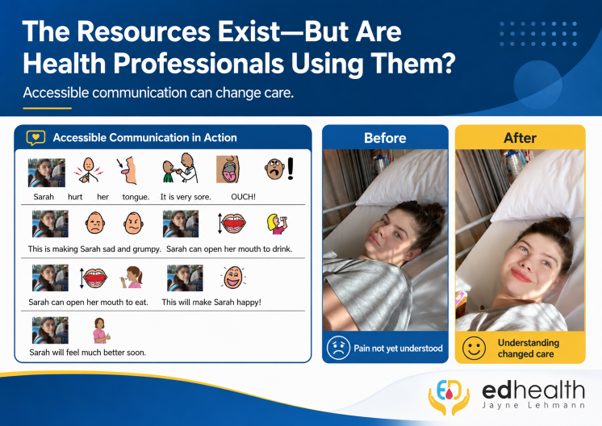
Once I understood what was wrong, I used the picture-based resource to explain to Sarah that I knew where the pain was and that we could get medicine to help it stop hurting so she could eat and drink again.
The change in her response was immediate. By chance, I captured photographs before and after that communication while we were playing with an app on my phone. You can see the resource and before and after photos above. I use these images in the presentations I do because they demonstrate the impact of accessible communication more powerfully than words alone.
Before deciding you are too busy for professional development in intellectual disability, ask yourself:
- Would I have looked in Sarah’s mouth on initial assessment, or later, to find the cause of her distress?
- Could our service adapt our communication to set people with intellectual disability up for equitable healthcare?
- Would we investigate a change in behaviour, appetite or participation as a possible health issue rather than simply attributing it to their disability?
The NDSS intellectual disability resources are free and available now. They are relevant to diabetes clinicians, doctors, nurses and allied health professionals—not only those who consider disability their specialty.
Engaging with them is a practical first step – plan when you will read the information and do the training course.
Equitable care requires more than allowing a person with intellectual disability to enter the same healthcare system as everyone else… it requires intentional steps to make the right things happen across all contact points between the person with intellectual disability and your health service.
#Diabetes4Disability #EdHealthAustralia #IntellectualDisability #DiabetesEducation #HealthEquity #InclusiveHealthcare #DiagnosticOvershadowing #DisabilityHealth #NDSS